Good Bones
28 Years Later, Bone Temple, and the immortality of a better world

When Carol Orzel visited the Mutter Museum to donate her bones, she had a request: Only if my jewelry can be displayed there, too. She spent her life advocating for the disabled and for research into the disease that marked her life, fibrodysplasia ossificans progressiva, or FOP. When she saw the bones of Harry Eastlack, another person with the same condition, she resolved to hang her bones next to his. They never met in life, and now they rest alongside each other behind plexiglass, a placard to tell their story.
After I visited the museum, I couldn’t stop thinking about her. Looking at her bones, her jewels, I felt a similar shiver of purpose. She demanded to be shown in her splendor as she donated her body to the cause she fought for all her life. She transfigured her bones into a story, into art. She became something that survives even now. She knew her bones would mean something. Deep down, we all do.
Last year, Danny Boyle and Alex Garland returned to the bleak, dangerous zombie apocalypse that helped launch their careers with their decades-later follow-up 28 Years Later. The film takes the hopeless, grainy darkness of 2002’s 28 Days Later, and evaporates it into a haze of foliage, light, and stunning implications.
Despite the multitude of fascinating characters, I fixated on Dr. Ian Kelson, the eccentric solitary doctor played by Ralph Fiennes. I couldn’t take my eyes off of his magnetic performance, watching him amble around the wasteland in bright orange skin (he coats himself in iodine to keep himself safe from the virus). His voice cuts through the miasma of bombastic score and woodland noise with a steel-wrapped velvet rigidity. This is a man who knows, who has not forgotten, and who endeavors to remain. This is a skeleton, surrounded by his jewels.
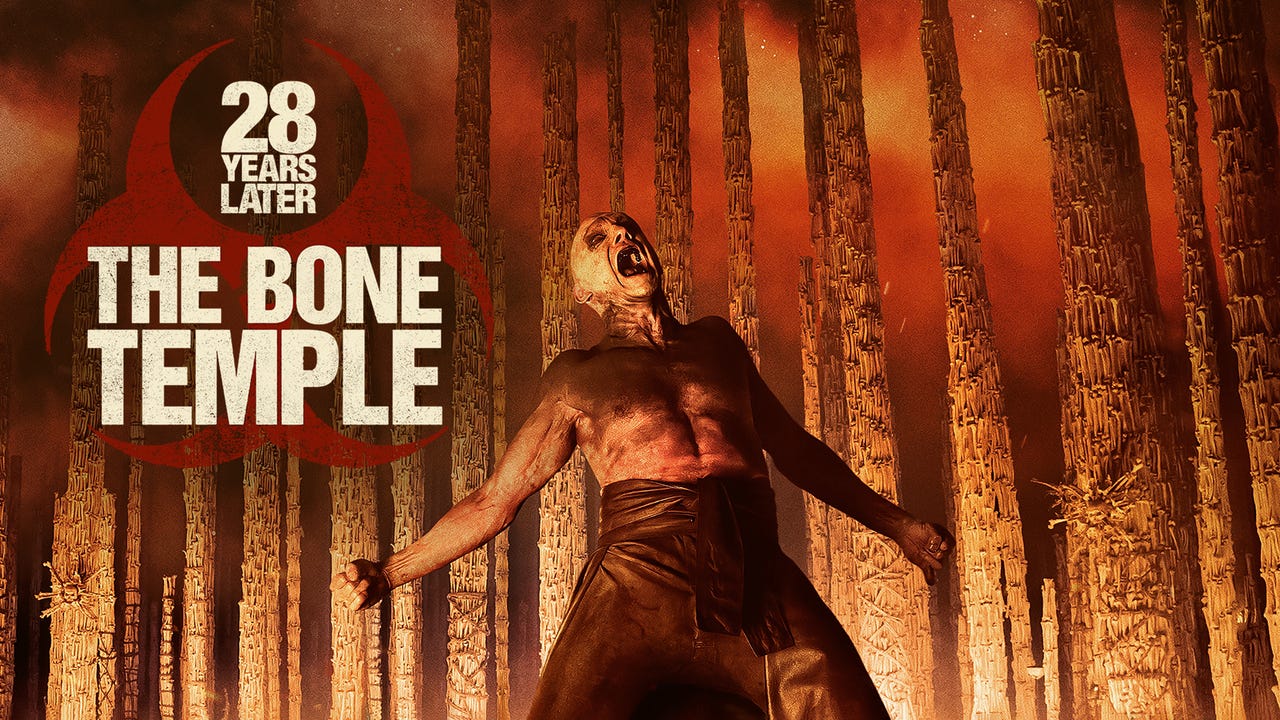
The jewels themselves, were the bones of countless dead, treated and bleached and fastened together into an awe-inspiring ossuary. He tells Spike, a young boy and the film’s protagonist, that the point of it all was to remember the dead. While the boy nodded knowingly, I sat in my comfy movie chair with a fistful of popcorn and remembered the lesson of Carol Orzel: the dead are for the living. Kelson’s bone temple helps connect him to his higher mission. It is how Kelson stays human in a hopeless world, surrounded by the venerated dead. It is how Kelson remembers compassion, turning the rage-filled “zombies” into corpses and those corpses into monuments.
The image was impactful enough to warrant its own follow-up film in Nia DeCosta’s 28 Years Later: Bone Temple. Also written by Garland and following Kelson and a cast of new characters, Bone Temple picks up right where the last movie left off, but with a tighter narrative and philosophical focus.
The film crystallizes Kelson’s worldview, honoring the dead with the building of something new. He researches the virus, experimenting and testing its limits with Samson, a massive, muscular, and ferocious looking “Alpha” evolved from the rage virus. Kelson saw the countless dead, the corpse of his old world, and turned towards a brighter future, driven by compassion.
In 1539, St. Francis Borgia was tasked with transporting the corpse of Isabella of Portugal, Queen of Spain, to her final resting place in Granada. The story goes that Francis saw her body, her beauty, so disfigured by death that he became a Jesuit and spent the rest of his life in service to God and his fellow man. He witnessed the corruption of her flesh and offered his life to another kingdom. Surrounded by the death of his past, Dr. Kelson was faced with a similar choice.
Throughout all of zombie media, the only solution to zombies is death. The pornographic head shot, the wanton swinging of machetes, the balletic couplings of improvised weapons and snarling undead faces all repeat over and over with no other way. We are surrounded by death in our stories of survival. In Bone Temple, just like Francis, we are presented with a different path. Kelson dares, in an underground bunker with nothing but what he can salvage, to fashion a cure. He seeks, amongst a garden of bones, to redeem the world with his knowledge of its past. He dances to his records, he writhes and shimmies and dreams. He believes, after each encounter with the terrifying Samson, that a cure is possible. His continued existence is a prayer for something better, something new.
In a world of ruins, weed covered buses and apartment buildings, Kelson dared to build something new. He dared to be a prophet for an age of new life.
Let’s face it: it was only a matter of time in this essay before the Bible showed up. As Kelson fretted over his pills in the dark of his underground bunker, below a towering ossuary, I thought of Ezekiel. Led by God to a valley of bones and asked “Son of man, can these bones live?” Ezekiel chose to trust him.
“Sovereign Lord, you alone know.”
And God knitted the bones back together into living flesh, as Ezekiel prophesied, showing him the impossible miracle of irredeemable bones, suddenly alive with possibility again.
Kelson is explicitly atheist in the film, played to hilarious effect when he is confronted by a pack of satanists, but his faith is gargantuan. If not in God, but in a better world. He is his own Ezekiel, trusting his cure to make living, reasoning flesh of his zombified world.
God told Ezekiel “Son of man, these bones are the people of Israel. They say, ‘Our bones are dried up and our hope is gone; we are cut off.’”
This world feels so dead sometimes. It is impossible to spend any amount of time in the comments of trans content creators without encountering the skeleton insult. “When scientists dig up your bones, they will say you are male.” Bone Temple presents a new answer to this crude, repeated dismissal.
But I have hope. When scientists dig up my bones they will find my faith. They will find a temple to who I was. They will find a roadmap to a better future. They will find an ossuary once entombed in skin that held, that touched, that wrote, that tried. They will find me buried with my jewels, posed next to my friends, all my poems a placard to tell our story.
They will turn from my yellowing valley of all my dry bones and believe.
They will believe and do better.